Women and public space
Cities for everyone
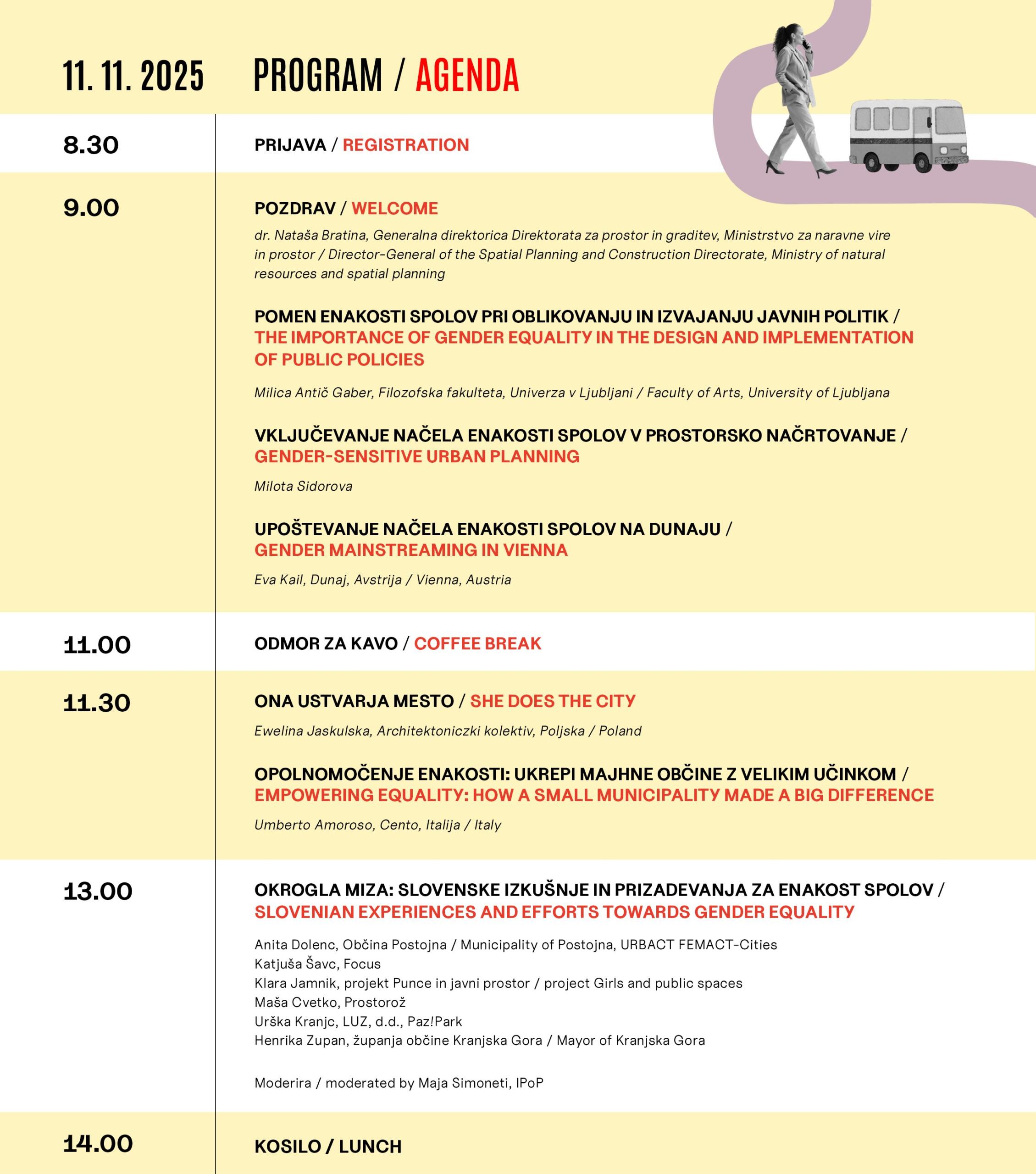
11 November 2025, 9.00 - 14.30
City museum Ljubljana, Gosposka 15
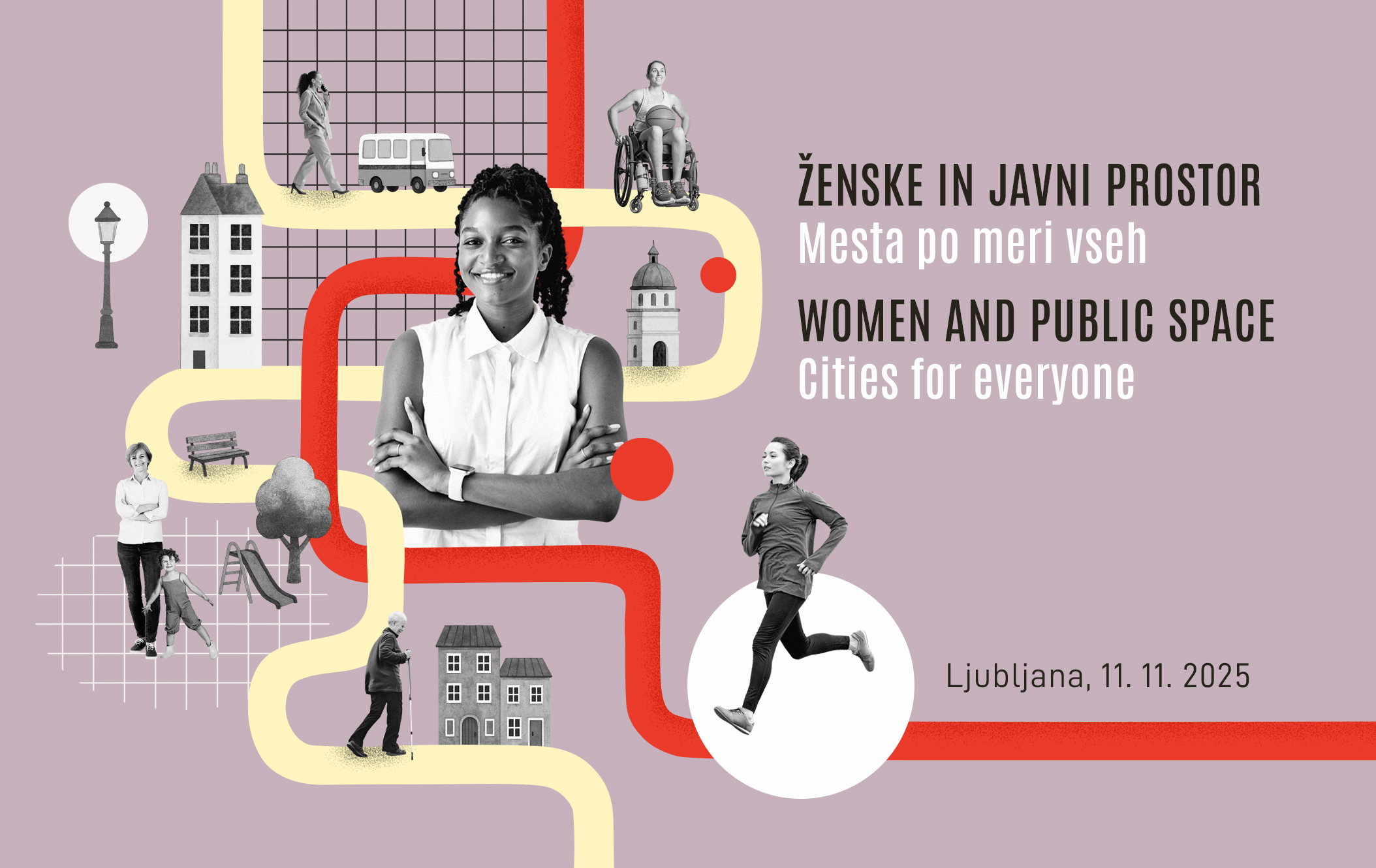
Graphi: Eva Mlinar
Cities for everyone
11 November 2025, 9.00 - 14.30
City museum Ljubljana, Gosposka 15
Graphi: Eva Mlinar
When designing urban policies and spatial plans, do we truly consider how different groups of people experience and use our cities — and how their backgrounds and circumstances shape those experiences?
Compared to other European countries, Slovenia ranks among the more successful nations in terms of gender equality. Women are equally represented in the labour market, and the gender pay gap is among the smallest in the European Union. Women also outperform men in education, with a higher share completing higher education.
In recent years, gender equality has increasingly become a topic of discussion within the European Union, particularly in the context of urban and spatial development. In this area, however, Slovenia may still be somewhat behind. Women’s political representation at the local level lags behind the national one — where, after the last elections, 40% of members of the National Assembly are women, and the gender balance in the European Parliament continues to improve. There is also a lack of systematic attention to, and fulfilment of, the specific needs of women and other population groups in spatial planning.
Are we aware of the importance of gender equality in the context of urban and spatial development?
Although cities are, in principle, meant to serve everyone, research shows that in practice, spatial planning does not treat the needs of women and men equally. Public spaces, transport and infrastructure, urban equipment, and even buildings are often designed for seemingly neutral, genderless users — but in practice, they mostly reflect the needs of healthy adult men.
The conference Women and Public Space: Cities for Everyone will highlight how more conscious, informed, and inclusive planning can create fairer public spaces that provide women and other specific groups — such as families with young children, children, and older people — with greater safety, comfort, usability, and a sense of belonging. We will discuss what kinds of planning and management of public space contribute to gender equality and ensure equal usability of spaces and buildings for all, regardless of gender, age, physical ability, or other personal circumstances.
Through presentations of examples from European cities and discussions of local practices, we will explore how urban planning changes when we place women’s experiences at the centre — recognising girls, younger and older women, mothers, grandmothers, workers, volunteers, pedestrians, and cyclists as key users of public spaces, buildings, and transport systems. The conference aims to raise awareness about the importance of social equality, showcase good practices, and encourage discussion about spatial and systemic solutions that improve the safety, mobility, and everyday lives of women in cities. It will also serve as an opportunity for networking and exchange of experiences among representatives of local communities, state institutions, and experts in spatial planning, urban policy, and gender studies.
Attendance is free. The conference will take place in Slovenian and English with simultaneous interpretation.
PRE-EVENT / 10. 11. 2025, 22:00
Join us for a WLINTA Night Walk – a nighttime walk through the city of Ljubljana, organized in collaboration with the international feminist collective Architektoniczki.
This walk is open to women, lesbians, intersex, non-binary, trans, and agender (WLINTA) people. Together, we’ll explore how we experience public space after dark – where we feel safe, where we don’t, and why.
The walk invites reflection on how cities are designed, lit, and inhabited at night – and opens up important questions: Who is the city really for? How can we shape safer, more inclusive urban spaces
To participate, please register at info@prostoroz.org.
Spots are limited.
The walk will be held in English.
Institute for Spatial Policies is the National URBACT Point (NUP) for Slovenia. As NUP we are communicating on the URBACT programme and…
In the coming months, the European network of Urban Contact Points, as the national info points for the European Cities Initiative (EUI)…
Mobility of Business and Industrial Zone for Improved Connectivity of Peripheral Areas
A project aimed at empowering communities to adapt to the impacts of climate change.
In 2025, our work continued to focus on sustainable mobility, resilient cities, governance support, and community empowerment. Below, we present the highlights...
By subscribing to our newsletter, you agree to our privacy policy.