Shared Landscapes
Shared Landscapes was a unique artistic project that used performances, stories and sensory experiences in the forest to explore nature as a common good. By bringing theatre into an urban forest, the project connected local communities, sharpened participants’ awareness of their surroundings and encouraged reflection on the role of forests in responding to the climate and environmental crises.

Foto: Maja Simoneti / IPoP
Shared Landscapes invited audiences to rediscover forests and other green spaces as places that are essential to our lives and shared by people, plants and animals.
The concept was conceived and curated by Caroline Barneaud and Stefan Kaegi (Rimini Protokoll). It brought together seven artistic works created for forests, meadows and fields. While the overall structure remained consistent, each presentation was adapted to its particular landscape, local community and performers, creating a unique theatrical and sensory experience at every location.
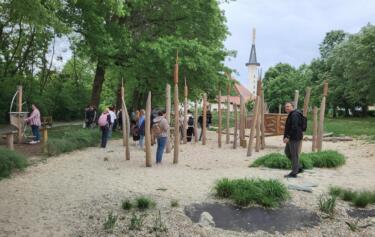
Over the course of several hours, audiences moved between different sites in the forest. Recorded stories, music and devices for observing and listening to trees encouraged participants to pay closer attention to the forest, its individual trees, its sounds and the other people experiencing the landscape alongside them.
The performances were interwoven with opportunities to walk, talk, spend time together and share an outdoor meal. Sun and rain were not disruptions but integral parts of an artistic experience shaped by the conditions of the natural environment.
For many visitors, most of whom were local residents, Shared Landscapes offered an opportunity to encounter a familiar urban forest from a new perspective. It encouraged a gentle and respectful approach to the landscape and raised questions about how people use, manage, appropriate and transform nature, despite being entirely dependent on it.
Shared Landscapes formed part of Performing Landscape, a cross-disciplinary European research platform represented in Slovenia by Bunker.
Our contribution
Our colleague Maja Simoneti worked with Bunker as a scientific contributor and adviser on the Ljubljana presentation, which took place as part of the Mladi Levi Festival.
She supported the Bunker team in selecting a suitable location and advised on coordination with the forest manager and landowners. She also prepared a description of the selected landscape and a thematic contribution exploring its environmental, social and spatial significance.
As part of the wider Performing Landscape programme, she participated in an international discussion with scientific contributors and experts involved in presentations in other European countries.
Koseški boršt: An Urban Forest Between the City and Its hinterland
Koseški boršt was selected as the Ljubljana venue because of its strategic location, distinctive landscape and accessibility.
The forest forms part of the wider urban forest within the Tivoli, Rožnik and Šiška Hill Landscape Park, a protected area of natural and cultural heritage. It has the status of a special-purpose forest, meaning that its social and ecological functions take precedence over commercial timber production.
Koseški boršt is also an important link between Ljubljana’s city centre and its green hinterland. It is a remnant of a once much larger peri-urban forest that was protected from development from an early stage in the city’s growth because of its importance to residents and its role as a shared space.
Later interventions, including the construction of Večna pot and facilities for the Biotechnical Faculty and Ljubljana Zoo, interrupted the natural transition between the city and the surrounding cultural and natural landscape. Nevertheless, much of the slightly wet and gently undulating forest has remained well preserved.
Its network of forest and park paths provides opportunities for long, peaceful walks and close contact with nature away from the routines of city life. At the same time, the area maintains visual and physical connections with both Ljubljana’s surrounding landscape and, across the wooded hills, the city centre.
Koseški boršt is a diverse mixed forest growing on relatively acidic soils. Its characteristic trees include beech, oak, sweet chestnut, fir and spruce. In places, the forest has a dense and varied herb layer, while clearings open towards the cultivated landscape on the city’s outskirts.
The forest also provides habitat for a rich variety of wildlife, including foxes, badgers and numerous bird species.
Duration: March–November 2024
Local partner and producer: Bunker