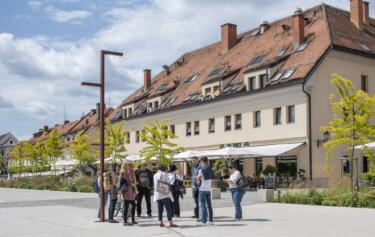
Active Travel to School and Healthy City

Foto: Luka Vidic
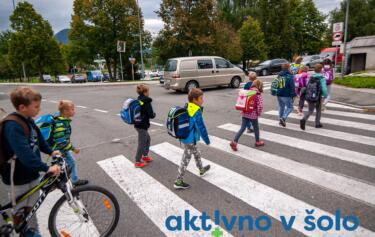
Active Travel to School and Healthy City is a long-term nationwide programme that promotes walking and cycling to school through organised Walking Buses and Bike Trains (links in Slovene). It raises awareness of the benefits of walking and active mobility for health, well-being and the development of both children and adults.
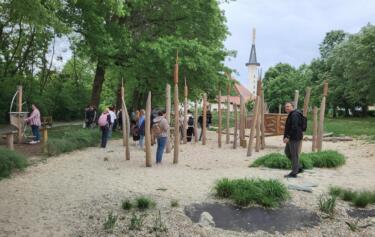
The programme also helps local communities create healthier, more walkable places. Through Local Walkability Plans, it strengthens the knowledge and skills needed to integrate walking, public health, transport and spatial planning.
Since 2015, the programme has used a community-based approach to develop and improve practical solutions that connect public health, sustainable mobility and spatial planning at the local level.
Active Travel to School and Healthy City, 2025–2028
The current programme continues all the key activities developed in previous years while placing an even stronger emphasis on promoting walking as part of everyday life.
Supporting children in walking and cycling to school remains at the heart of the programme. Schools and local communities receive support in organising Walking Buses and Bike Trains, complemented by the introduction of designated Kiss and Ride drop-off points. Together, these measures aim to enable children to travel to school more independently, safely and healthily.
The programme also continues the nationwide monitoring of school travel through the updated How Do We Travel to School? platform. The platform supports the collection, analysis and public presentation of data on how children currently travel to school and how they would prefer to travel, both locally and nationally.
The data provide a basis for discussing the opportunities and conditions for active travel to school, as well as the transport and spatial-planning measures needed to create healthier living environments. Schools can monitor changes in travel behaviour and preferences over time, while schools and municipalities can use the findings to plan targeted local improvements.
The programme’s second main pillar is the development of Local Walkability Plans. These plans help communities recognise walking as a fundamental mode of transport and integrate it into transport and spatial planning.
A practical guide to preparing a Local Walkability Plan is available to interested municipalities and professionals. The programme will also organise two regional training sessions for spatial and transport planners and municipal representatives.
A national communication campaign will connect the programme’s activities. It will highlight the wide-ranging benefits of walking for people and the environment, encourage walking for everyday journeys, and promote the development of walkable neighbourhoods and communities.
Lead organisation: IPoP – Institute for Spatial Policies
Partner: CIPRA Slovenia, Association for Protection of the Alps
Co-funded by: Ministry of Health of the Republic of Slovenia
Active Travel to School and Healthy City, 2022–2025
During this period, the programme focused on turning accumulated knowledge into practical action.
Alongside continued support for Walking Buses and Bike Trains and the further development of the How Do We Travel to School? platform, the programme produced and presented the guide Planning Healthy Cities Together! The guide brings together practical examples and tested methods for creating walkable, health-supportive environments.
The programme strengthened the understanding of walking as a mode of transport that contributes simultaneously to public health, social equity, environmental protection and climate-change mitigation.
Training and support were provided to six selected municipalities and planning teams. Particular attention was given to building local alliances, involving residents in planning processes, and improving cooperation between the public-health, spatial-planning and transport sectors.
Lead organisation: IPoP – Institute for Spatial Policies
Partner: CIPRA Slovenia, Association for Protection of the Alps
Co-funded by: Ministry of Health of the Republic of Slovenia
Active Travel to School and Healthy City, 2019–2022
This phase of the programme was the first to systematically connect active travel to school, public health and spatial planning.
Its main activities included supporting schools and municipalities in organising Walking Buses and Bike Trains and promoting the Healthy City concept.
The programme encouraged the creation of local partnerships and developed a process, methodology and set of tools for preparing Local Walkability Plans. These approaches were tested in three pilot municipalities.
Educational seminars strengthened knowledge, cooperation and coordination across different sectors. This work established the foundations for the programme’s further development in subsequent years.
Lead organisation: IPoP – Institute for Spatial Policies
Partner: CIPRA Slovenia, Association for Protection of the Alps
Co-funded by: Ministry of Health of the Republic of Slovenia
Active Travel to School, 2017–2019
The Active Travel to School programme built on the first experiences of organising accompanied journeys to school through Walking Buses and Bike Trains. It expanded the focus from individual school journeys to the wider school neighbourhood.
The programme began to address the spatial and traffic conditions affecting school routes in a systematic way. Working with a selected municipality and its schools, it used an inclusive process to update the local school-route plan.
Children and other local stakeholders helped identify practical measures to improve walking conditions around schools.
The programme reinforced the understanding that the decision to walk is not simply a matter of personal choice. It is strongly influenced by the design and quality of public space, road safety and people’s sense of comfort and security.
This phase paved the way for closer cooperation between schools, municipalities, sustainable-mobility specialists and spatial-planning professionals.
Lead organisation: IPoP – Institute for Spatial Policies
Partners: CIPRA Slovenia, Association for Protection of the Alps; Focus, Association for Sustainable Development
Co-funded by: Ministry of Health of the Republic of Slovenia
Healthy Schoolchild, 2015–2016
The Healthy Schoolchild project laid the foundations for all subsequent activities.
It focused on active travel to school through Walking Buses and Bike Trains and on supporting the health, independence and social development of primary-school children.
The programme demonstrated that children and parents are willing to change their travel habits when safe and supportive conditions are in place. It also showed that relatively simple organisational measures can have a significant effect on everyday mobility patterns.
The experience gained through Healthy Schoolchild led directly to the further development and expansion of the programme.
Lead organisation: IPoP – Institute for Spatial Policies
Partners: Focus, Association for Sustainable Development; Gekolina; Ljubljana Cyclists’ Network; Slovenian Coalition for Public Health, Environment and Tobacco Control; Eko-Humanitatis Institute; Studio 12; Maribor Cycling Network
Co-funded by: Ministry of Health of the Republic of Slovenia