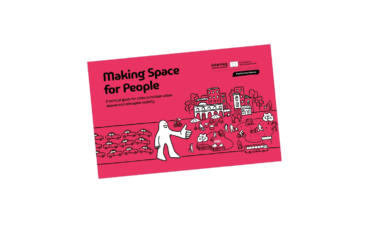
The Making Space for People toolkit, developed within the Pop Up Urban Spaces – Facilitating shift towards active forms of mobility with the use of tactical urbanism project, presents tactical urbanism as an approach to planning and improving public space through temporary, low-cost and adaptable spatial interventions. It is intended for municipalities, professional services, organisations and local communities seeking to test new spatial arrangements in practice, engage users of public space, and support long-term spatial and mobility-related changes based on experience and evaluation. The toolkit provides practical guidance for planning, implementing and assessing temporary interventions that contribute to more high-quality, safe, inclusive and vibrant public spaces.
The catalogue Cities to Cities #3: a catalogue of good practices of Slovenian cities for sustainable urban development presents 15 out of the 29 good practices of Slovene cities selected after an open call in the fall of 2020.
At IPoP, we are in contact with many Slovenian municipalities and are often impressed by the solutions that municipalities come up with while facing challenges in the field and in caring for the quality of life of their citizens. Over time, we have come to realize that the practices of Slovenian municipalities are no less inspiring than the good practices of URBACT, and that a better knowledge of them could benefit other municipalities in Slovenia as well. Last but not least, the context in which these practices developed is probably much closer to Slovenian municipalities than those from more remote cities across Europe.
Good practices offer solutions to different challenges Slovene cities are facing, from encouraging sustainable mobility to the management of construction waste, planning playgrounds together with children, solving the space constraints of cemeteries and the inclusion of vulnerable groups.
The catalogue is intended primarily for Slovene municipalities, so it is written in Slovene. But we do believe these good practices can be interesting for other cities around Europe, so we have written a short English description for each good practice.
The catalogue Cities to Cities #2: a catalogue of good practices of Slovenian cities for sustainable urban development builds on the approach of the first one, where we presented 13 of the 97 good practices of URBACT cities, but this time it highlights exclusively domestic good practices. As a National URBACT point, we want to share good practices among other Slovenian municipalities and inspire them to introduce new approaches to sustainable urban development.
Publication Spatial policies: about community challenges between Ljubljana and Seul hold a collection of papers, that offer various critical views on spatial and urban development, emphasise the meaning of thought-through public policies and their spatial effects on quality of life in the cities as well as it talks about innovative spatial practices in the context of world urban trends.
English abstracts of papers are available in the publication.
Jane’s Walk was started in 2007 to commemorate and celebrate the life and ideas of Jane Jacobs, and now has become an event hosted by cities around the world. Jane Jacobs’ call to ‘get out and walk’, to learn about your city and get involved, has inspired volunteer walk leaders to share and converse about their neighbourhoods and meaningful places. The Jane’s Walk event continues to grow globally and we are excited to see how well it has been received in Slovenia.
Summary available in Slovene.
A Booklet on sustainable spatial planning is aimed at the general public to help involve it into spatial planning processes, its content relates to an information platform of advocates of environment “Zagovorniki okolja”. The Reader is designed to explain how the idea of sustainable development is related to spatial planning and environmental protection, how the Slovenian spatial planning system is integrated into this framework and how the characteristics of a sustainable approach are reflected in the spatial planning practice.
Whole summary available in Slovene at the end of the Reader.